
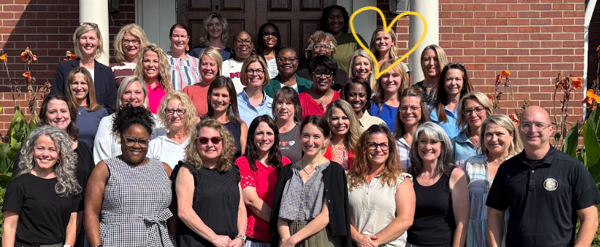
Thirty-eight school counselors recently came together in Franklin, Tennessee to prepare for some of the most difficult moments a school community can face—and to build connections that can extend well beyond their own districts.
When a crisis affects a school, the immediate response may happen within hours or even minutes. The work of helping students, educators, and families recover, however, can continue for weeks, months, or longer.
That is why these 38 school counselors spent two days developing specialized skills in crisis response and recovery through the Southern Regional Education Board’s (SREB) Crisis Recovery Network. Linda Tyree, director of the network, said, “We can’t take away someone’s pain after a school-impacting crisis, but we can lessen the traumatic impact by responding effectively, appropriately, and compassionately—and by making sure no one has to walk through it alone.”
Representing 17 school districts and four universities across Tennessee, as well as guests from Mississippi and Georgia, the counselors learned how to provide psychological first aid and stabilization, assess the needs of a school community, and support students and staff as they begin the process of moving forward after a traumatic event.
But the value of the experience extends beyond the skills being developed in the training room. The counselors are also getting to know colleagues from across the state—professionals who may one day be called upon to support one another when a school community is facing circumstances that exceed its existing resources.
Preparing before the need arises
School crises can take many forms. A community may be coping with the sudden death of a student or staff member, a natural disaster, a serious accident, an act of violence, or another event that significantly disrupts the school environment. Although schools have emergency plans to address the immediate response, the challenge often comes in the days and weeks that follow, when students and staff return to classrooms and begin trying to make sense of what happened.
The SREB Crisis Recovery Network is designed to strengthen that longer-term recovery capacity. The network is building teams of trained school counselors across SREB’s 16-state region who can complement—not replace—the crisis resources already available within schools and districts.
Dr. Brittany Sweet, School Counselor at Eaton Elementary School said, “This was one of the most meaningful workshops I have ever attended, because I am not only able to bring valuable skills and resources back to my school, but I am also better prepared to serve my state if I am ever called upon following a catastrophic event. Being part of this network is a reminder of the important role schools counselors can play in helping communities heal and recover.”
For the Tennessee counselors participating in the training, preparation means being better equipped to recognize what a school community needs following a crisis and to respond in ways that promote safety, connection, and recovery. Participants will continue to learn strategies to establish psychological safety, provide psychological first aid, identify crisis-related concerns, and connect students and staff with appropriate support. The training incorporates the PREPaRE model, a nationally recognized approach developed by the National Association of School Psychologists.
Rather than simply discussing what to do in a crisis, counselors work through realistic situations and practice applying the skills they are learning. The scenarios encourage participants to consider the unique needs of students, staff, and school communities while reflecting on how their response can support recovery.
A statewide network starts with relationships
One of the most important outcomes of bringing counselors together from across Tennessee may be something that cannot be captured on a training agenda: connection.
School counselors know their own schools and communities well. They also know that no school is immune from unexpected tragedy, and that the needs created by a major crisis can sometimes exceed what a single school or district can manage alone.
Developing relationships with counselors from other parts of the state creates another layer of support.
“Preparedness is more than knowing what to do in a crisis—it’s knowing who you can turn to when your school community needs additional support. This network gives us that connection. The greatest strength of this network is knowing that when a school community experiences a crisis, we don’t have to face it alone.” said Amy Hallman, School Counselor from Innovation Academy in Springfield, TN.
The counselors participating in this training are joining SREB’s growing Crisis Recovery Network and will have opportunities to remain connected with other trained professionals. When significant events occur, that network can provide a way for counselors to share knowledge, experience and support while working alongside local school teams.
The goal is not to create a system that replaces the people who know a school best. Instead, it is to make sure those professionals have additional resources and colleagues to turn to when the circumstances are particularly challenging.
For Tennessee, the work begins with these SREB Crisis Recovery Network members. They are returning to their schools with new skills, new relationships and a shared understanding that preparedness starts long before a school-impacting crisis occurs. It is about having people who are ready to respond, support one another and help a school community take the next steps toward healing when the unexpected happens.
Tennessee Crisis Recovery - Jennifer Huckaby, Anderson County; Beth Coules, Shelli Bond, and Caitlin Bourke from Bartlett City Schools; Jordan Tatom from Bedford County Schools; Shannon Cochran and Leah Walker from Bradley County Schools; Ashley Dale, Leslie Parreco, and Tammy Smith from Clarksville-Montgomery County; Teresa McGuire and Latisha Harp from Compass Community Schools; Hillary Jackson from Dyersburg City Schools; Kim Luther from Fentress County; Crystal Sorrels from Hamilton County, Karen Whidby from Lipscomb University; Brittany Sweet from Loudon County; Gloria Anderson from Memphis-Shelby County Schools; Shemeka Beadle Rush from Metro Nashville; Christine Lewis from Middle Tennessee State University; Amy Hallman and Janine Wade from Robertson County; Suzanne Boynton from Sequatchie; Andrea Parson from Tullahoma City Schools; Michelle Brasfield from the University of Memphis, Alexandra Frank from the University of Tennessee at Chattanooga; Clanci Tipton from Washington County, Brittney Lindsey, Heather Poland, and Robbie Whitaker from Wilson County.